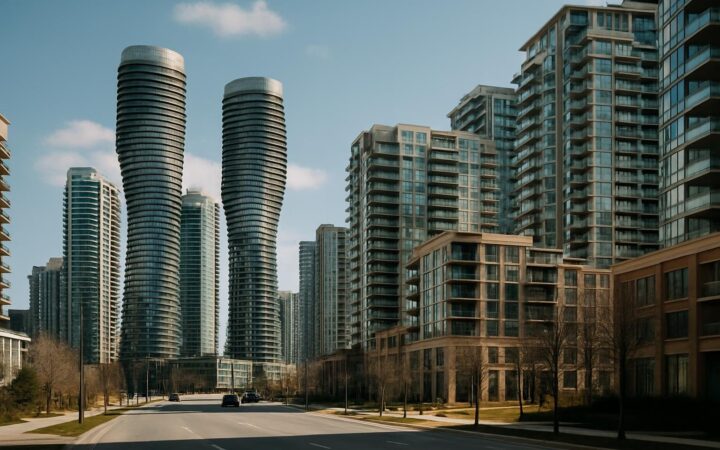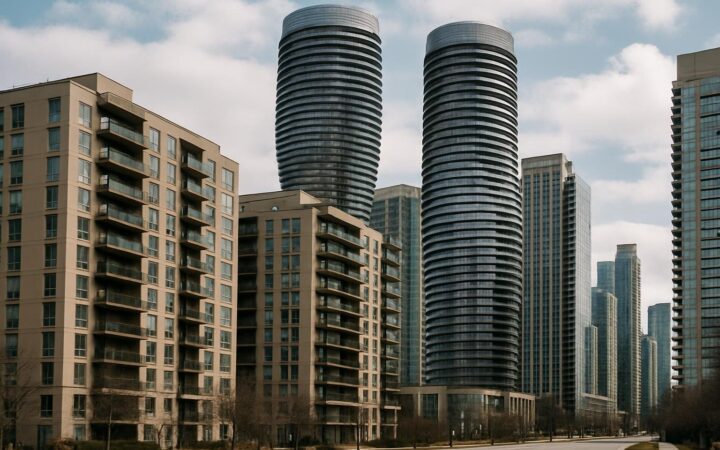

Mississauga condo costs for a first-time buyer usually include the deposit, down payment, mortgage insurance if under 20% down, Ontario land transfer tax after any eligible rebate, legal and adjustment costs, and monthly expenses such as mortgage payments, condo fees, property tax, insurance and utilities. Recent resale condo prices make $500,000–$600,000 a useful planning range.
Key takeaways
- Mississauga condo costs are not just the purchase price; the timing of the deposit, down payment and closing funds matters.
- September 2026 resale condo data points to about $500,000 average pricing, but individual units can vary materially.
- A first-time buyer purchasing at $500,000 needs a $25,000 minimum down payment under Canada’s minimum down payment rules.
- A first-time buyer purchasing at $600,000 needs a $35,000 minimum down payment under the same rules.
- If the down payment is under 20%, mortgage loan insurance and Ontario sales tax on the premium can affect the cash required.
- Monthly carrying costs should include condo fees, property tax, insurance, utilities and a repair or emergency buffer.
What do Mississauga condo costs include for a first-time buyer?
Mississauga condo costs start with the price of the unit, but the real budget has three layers: cash needed before closing, cash needed on closing, and ongoing monthly carrying costs after you move in. A buyer who only looks at the listing price can be surprised by timing, especially because the deposit may be due soon after an offer is accepted.
The simplest way to organize Mississauga condo costs is to separate them into these buckets:
- Offer-stage cash, mainly the deposit.
- Down payment funds available for closing.
- Mortgage loan insurance costs if the down payment is less than 20%.
- Ontario land transfer tax, after any first-time buyer refund that applies.
- Legal fees, title insurance, adjustments and other professional or lender-related costs.
- Monthly costs after closing, including mortgage payments, condo fees, property tax, insurance and utilities.
A deposit is not the same thing as a down payment. The deposit is part of the purchase contract and is usually paid with, or shortly after, the accepted offer. The down payment is the buyer’s equity contribution toward the purchase price; the mortgage covers the rest. In many resale condo transactions, the deposit is credited toward the total cash required on closing, but there is no fixed official Mississauga deposit amount. It is negotiated in the Agreement of Purchase and Sale and can vary with price, conditions, competition and seller expectations.
How much are Mississauga condo costs based on current prices?
Recent resale condo data gives first-time buyers a useful starting point, although it should not be treated as a quote for a specific unit. A Mississauga condo market page reporting figures compiled from TRREB MLS® sales showed 122 condo apartment sales in September 2026, with an average price of $501,000 and a median sold price of $430,000, based on data shown as of October 21, 2026 from Valery Real Estate.
A separate Mississauga page stating that it uses TRREB Market Watch, September 2026 data, reported a condo apartment average price of $500,000, 122 sold units, 831 for sale and 6.8 months of inventory from CondoInvestments.ca.
That does not mean every buyer should assume Mississauga condo costs will be exactly $500,000. Unit size, building age, parking, locker, location, exposure, floor level, condition, amenities and condo fees can all move the total cost materially. For a first-time buyer building a first budget, however, $500,000 to $600,000 is a practical example range for testing down payment, land transfer tax and monthly affordability.
How do Mississauga condo costs break down before closing?
The first major calculation is the minimum down payment. The Financial Consumer Agency of Canada states that the minimum down payment is 5% for homes of $500,000 or less; for homes from $500,000 to $1.5 million, it is 5% of the first $500,000 plus 10% of the amount above $500,000; and for homes of $1.5 million or more, it is 20% under Canada’s down payment rules.
For Mississauga condo costs at common example prices, the minimum down payment works like this:
- At a $500,000 purchase price, the minimum down payment is $25,000. The base mortgage before insurance would be $475,000.
- At a $600,000 purchase price, the minimum down payment is $35,000. That is $25,000 on the first $500,000 plus $10,000 on the amount above $500,000. The base mortgage before insurance would be $565,000.
- At a $700,000 purchase price, the minimum down payment is $45,000. That is $25,000 on the first $500,000 plus $20,000 on the amount above $500,000. The base mortgage before insurance would be $655,000.
If the down payment is less than 20%, buyers typically need mortgage loan insurance. Canada’s consumer mortgage information says mortgage loan insurance premiums can range from 0.6% to 4.5% of the mortgage amount on insured mortgages. The standard CMHC premium for a 90.01% to 95% loan-to-value ratio is 4.00% in the CMHC program materials published by CMHC.
Using minimum down payments and that 4.00% premium level, the examples look like this:
- At $500,000, a $475,000 base mortgage would have a $19,000 insurance premium. Ontario 8% PST on that premium would be $1,520.
- At $600,000, a $565,000 base mortgage would have a $22,600 insurance premium. Ontario 8% PST on that premium would be $1,808.
- At $700,000, a $655,000 base mortgage would have a $26,200 insurance premium. Ontario 8% PST on that premium would be $2,096.
The mortgage insurance premium is often added to the mortgage, but the Ontario sales tax on the premium must be paid in cash. Lenders can also require more than the minimum down payment based on credit, income, debt, property type or insurer rules, so a mortgage pre-approval should be based on current documents rather than a rough online estimate.
Which closing costs apply when buying in Mississauga?
Land transfer tax is usually one of the largest closing costs. For Ontario, the first-time homebuyer land transfer tax refund can be up to $4,000 for eligible buyers, and qualifying first-time buyers pay no Ontario land transfer tax on the first $368,000 of value under the Ontario refund program. Mississauga does not have a separate municipal land transfer tax like Toronto, so the examples here focus on Ontario land transfer tax.
Using the Ontario land transfer tax rates in the brief and the maximum first-time buyer rebate, example net land transfer tax amounts are:
- At a $500,000 purchase price, Ontario land transfer tax before rebate is $6,475. After a maximum $4,000 first-time buyer rebate, the net amount is $2,475.
- At a $600,000 purchase price, Ontario land transfer tax before rebate is $8,475. After a maximum $4,000 first-time buyer rebate, the net amount is $4,475.
- At a $700,000 purchase price, Ontario land transfer tax before rebate is $10,475. After a maximum $4,000 first-time buyer rebate, the net amount is $6,475.
Rebate eligibility can depend on all buyers’ status, spouse or common-law history, occupancy, citizenship or permanent residency rules, and title shares. If one buyer is not eligible, the refund may be reduced.
Other closing items vary by buyer, lender, lawyer and property. Budget room for:
- Real estate lawyer fees and disbursements.
- Title insurance.
- Appraisal fee, if the lender requires one.
- Home inspection, if you choose one.
- Moving costs.
- Utility setup or deposits.
- Property tax and condo fee adjustments on closing.
For new or pre-construction condos, the cost picture can be different. Buyers should ask about HST treatment, development charges or levies, warranty-related costs, occupancy fees and builder adjustments before signing. Those items are not the same as a typical resale condo budget.
How should first-time buyers estimate monthly Mississauga condo costs?
Monthly Mississauga condo costs should be estimated before viewing units, not after falling in love with one. The purchase price matters, but condo fees can make two similarly priced units feel very different month to month.
A practical monthly budget should include:
- Mortgage payment.
- Condo maintenance or common expense fee.
- Property tax.
- Home or condo insurance.
- Utilities not included in the condo fee.
- Parking or locker costs if rented separately.
- Internet.
- Routine repairs and replacement costs inside the unit.
- Emergency buffer.
- Possible future condo fee increases or special assessments.
Condo fees deserve close attention because they are not optional. They support the shared costs of the building and can change over time. A lower purchase price is not automatically more affordable if the monthly fee is high, if utilities are excluded, or if the building may need major work.
Before making an offer, buyers should plan to have the condominium documents reviewed by the appropriate professionals. The goal is to understand what the condo fee covers, whether there are arrears or legal issues, and whether the building’s finances could affect future ownership costs.
What can change your total budget?
Pre-construction Mississauga condo costs can look very different from resale costs because the payment timing and builder adjustments may be different. This article is mainly about first-time buyers planning for a resale condo, where the budget is usually easier to estimate once the purchase price, deposit, mortgage terms and closing date are known.
For any condo, your total budget can change because of:
- A higher or lower accepted purchase price.
- A lender requiring more than the minimum down payment.
- Mortgage insurance if the down payment is under 20%.
- The amount and timing of the offer deposit.
- Whether the buyer qualifies for the full land transfer tax refund.
- Legal, title, appraisal, inspection and moving costs.
- Condo fee level and what it includes.
- Property tax adjustments on closing.
- Future building repairs, fee increases or special assessments.
This is why a first-time buyer should not shop at the absolute top of a pre-approval without understanding the cash needed on closing and the monthly carrying cost after closing. A lower purchase price with a higher condo fee can sometimes carry like a higher-priced unit with a lower fee, so both sides of the equation matter.
A practical next step for Mississauga condo costs
To make Mississauga condo costs easier to manage, build a one-page budget before touring properties. Start with three prices, such as $500,000, $600,000 and $700,000. For each one, write down the minimum down payment, estimated insurance premium and tax if applicable, estimated land transfer tax after any rebate, and a monthly budget that includes condo fees, property tax, insurance and utilities.
Then compare that budget with your available cash, emergency savings and lender pre-approval. If the closing cash or monthly payment feels tight on paper, adjust the search range before making an offer. A careful budget does not remove every risk, but it can help you decide which units are realistic before you commit to a purchase.
This article is general information and not financial or legal advice.
Related reading
- Buying a condo in mississauga: Complete Buyer Guide
- Mississauga Condo Neighbourhoods: Where to Buy
- Mississauga condo maintenance fees in 2026: Budget Guide
Frequently asked questions
How much cash does a first-time buyer need for a Mississauga condo?
It depends on the purchase price and lender requirements. As planning examples, a $500,000 condo has a $25,000 minimum down payment, while a $600,000 condo has a $35,000 minimum down payment under Canada’s minimum rules. Buyers also need cash for deposit timing, land transfer tax, insurance tax if applicable, legal costs and adjustments.
Is the deposit the same as the down payment?
No. The deposit is paid with or shortly after an accepted offer and is part of the purchase contract. The down payment is the buyer’s equity contribution toward the purchase price at closing. In many resale purchases, the deposit is credited toward the total cash needed on closing, but the amount is negotiated.
Do first-time buyers pay land transfer tax in Mississauga?
First-time buyers may still pay Ontario land transfer tax in Mississauga, but eligible buyers can receive a refund of up to $4,000. Based on the examples in this article, the net Ontario land transfer tax after the maximum rebate would be $2,475 on $500,000 and $4,475 on $600,000.
What monthly costs should I include besides the mortgage?
A condo budget should include the mortgage payment, condo maintenance fee, property tax, condo insurance, utilities not included in the maintenance fee, internet, repairs and an emergency buffer. Buyers should also consider future condo fee increases or special assessments, especially if the building has upcoming major repairs.
Are $500,000 to $600,000 examples realistic for Mississauga condos?
They are useful planning examples, not a price guarantee. September 2026 Mississauga condo data cited in the article showed average resale condo pricing around $500,000, with the median lower. Unit size, age, parking, locker, location, view, building condition and condo fees can all materially change affordability.